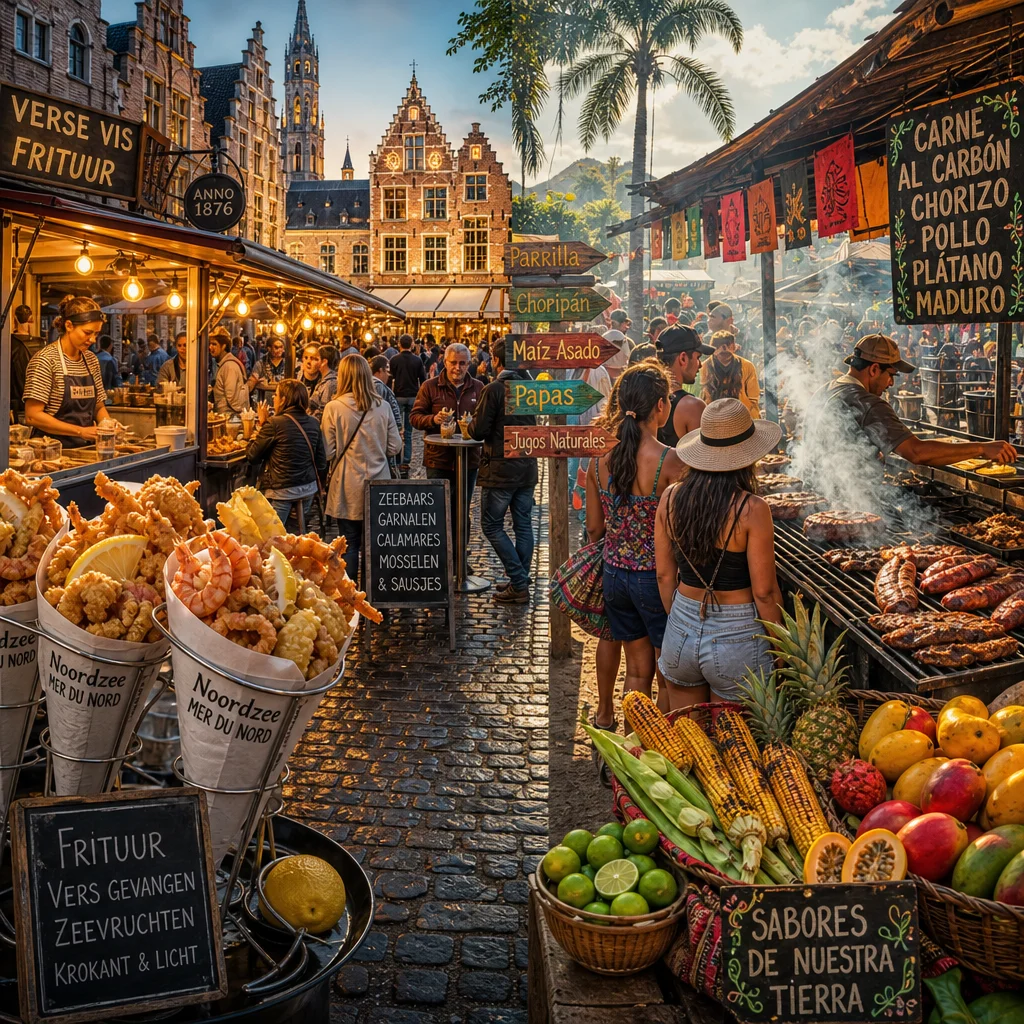
Every urban landscape hides a dual identity. There is the formal city of white tablecloths and reserved tables, and then there is the real city, which reveals itself on the pavement through the hiss of hot oil and the smoke of charcoal grills. Street food is the most direct bridge between a destination and its authentic appetite. There are no reservations, no translated tourist menus, and zero culinary ceremony. You simply stand shoulder to shoulder with hospital nurses, taxi drivers, university students, and office clerks, and you eat precisely what they eat. This field guide explores the historic market stalls of Europe and the vibrant open-air kitchens of South America, tracking how the universal economic law of fast preparation and affordable pricing yields entirely distinct flavor profiles on each continent.
Along the journey, we will dissect the financial realities of running a mobile food cart, the unwritten etiquette that keeps a fast-moving queue flowing smoothly, and the practical health rules that ensure you remain a welcome guest rather than a patient. Whether you are mapping out a culinary expedition across two continents or simply curious why a humble paper cone of fried potatoes can function as a cultural manifesto, these observations offer a reliable roadmap.
Why Street Food Tells the Truest Story of a City
A sit-down restaurant sells an evening’s entertainment; a street food vendor sells an enduring habit. The culinary operators who manage to survive in the same pitch for decades are rarely catering to fickle tourists. They endure because an entire neighborhood relies on them for a swift lunch at eleven in the morning and a hot, comforting snack at nine at night. That deep economic and social dependency enforces a rigorous standard of honesty. Prices remain low, portions stay satisfyingly generous, and recipes are stubbornly local because the regular clientele would notice a compromised shortcut immediately.
Furthermore, street food serves as edible migration history. A Berlin currywurst, a Sicilian panelle, a Peruvian anticucho, and a Brazilian pastel each point directly to historical movements of soldiers, dockworkers, farmers, and factory shift workers. When you ask a street vendor about the origin of their batter or spice rub, you are essentially unlocking a micro-history of the neighborhood, and most proprietors will gladly recount the tale while their frying oil sizzles.
There is also an undeniable practical advantage for the traveler. Street food offers the most cost-effective method to study a culinary culture’s foundational building blocks. A single afternoon sampling small bites can teach you more about regional spice combinations, textural preferences, and flavor balances than three expensive dinners, and it does so at a fraction of the cost.
Europe: Markets as Neighborhood Kitchens
European street food is fiercely regional, and its finest iterations historically refused to travel far. Palermo’s crispy chickpea fritters, Naples’ folded and fried pizzas, Istanbul’s grilled mackerel sandwiches, and Lisbon’s delicate custard tarts are all constructed strictly from whatever ingredients the local port or surrounding countryside delivered that very morning. Historic markets serve as the natural epicenters: the exact paved square that operates as a vegetable market at dawn transforms into a hot food kitchen by noon, with both halves of the day operating as a continuous civic service.
The common thread uniting these diverse traditions is historical frugality. Street food was traditionally born from inexpensive cuts of meat and leftover starches: tripe, offal, day-old bread, chickpea flour, and potatoes. The true genius of European street cooking is that material scarcity bred intense flavor rather than blandness. A simple ration of pulse flour is transformed into a crisp, golden panelle, while a pot of chickpeas becomes a warming, spiced soup served in a paper cup on a chilly winter morning.
The Mediterranean Edge
In Italy, street food functions as a proud badge of regional identity. Romans queue up for supplì, deep-fried rice croquettes featuring a molten mozzarella center. Neapolitans fold pizza dough around rich ricotta and cured salami before frying it to order. Sicilians tuck panelle into sesame seed rolls splashed with fresh lemon juice, while in Catania locals indulge in a warm brioche bun stuffed with artisanal gelato for breakfast. These are not novelty items engineered for visitors; they represent the daily rhythm of breakfast, lunch, and the walk home.
Greece and Turkey rely heavily on the art of the grill. Souvlaki and döner are architectural marvels: flatbread, succulent meat, fresh tomatoes, onions, sauce, and a strict sequence of assembly repeated thousands of times each evening. Observe the vendor’s hands closely. A master grill cook can construct a tightly wrapped gyro in under twenty seconds without ever looking down at the counter, achieving a structural balance that slower, overthought preparations rarely match.
Northern Cool and Eastern Smoke
Northern Europe evolved along a different trajectory. Copenhagen’s modern market halls and Amsterdam’s historic herring carts prioritize speed, seasonality, and preservation over fiery spice. Pickled fish, dense rye bread, and fried snacks dominate because harsh climates historically made preservation the central culinary skill. The culinary pleasure here relies on bold contrasts: something sour, something rich, and something crunchy, consumed outdoors in crisp, cold air.
Central and Eastern Europe operate on a philosophy of smoke and comforting starches. Hungarian lángos—a deep-fried flatbread rubbed with garlic oil and topped with sour cream and grated cheese—is engineered to be consumed while standing on a freezing sidewalk. Polish zapiekanka, a toasted open-face baguette piled high with sautéed mushrooms and melted cheese, remains a legendary late-night institution. Czech and Slovak markets push heavy grilled sausages paired with sharp mustard and dark rye bread. These are foods purpose-built for harsh weather, and they invariably taste out of place inside a heated room.
Crossing the Atlantic: What Changed and What Stayed
The Atlantic exchange transformed global street food more profoundly than any other single historical event. Indigenous crops from the Americas, including maize, potatoes, tomatoes, and chilies, permanently revolutionized European cooking. In the reverse direction, wheat, cattle, pigs, and advanced frying techniques arrived in ports that quickly forged their own hybrid traditions. Every signature street dish in South America serves as a tangible record of this cross-continental exchange, layered over ancient Indigenous foodways and the tragic forced migration of enslaved Africans.
The most profound structural difference lies in the grain. While European street food relies predominantly on wheat, potatoes, and rice, South America is ruled by the comal (griddle) and corn dough. Arepas, tamales, tortillas, humitas, and empanadas all descend directly from an ancient maize-based culinary civilization, and the aroma of toasted corn dough at dusk is the continent’s shared sensory signature.
South America: Fire, Corn, and Patience
South American street food frequently rewards patience. A vast portion of the menu is grilled over glowing charcoal or seared on a flat iron right before your eyes, transforming the vendor into a performance artist as much as a cook. Anticuchos in Lima—skewers of marinated beef heart brushed generously with vibrant ají sauce—are grilled to order in under three minutes, yet they have spent hours absorbing aromatic marinades. The wait is an integral part of the transaction, and standing by the cart watching your meal take form is part of the overall experience.
Portion structures also differ significantly. Where a European stall might hand you a single handheld item, a South American vendor often assembles a balanced plate: a starch, a protein, a signature sauce, and something acidic or pickled on the side. This reflects a deep culinary tradition where nutritional and flavor balance is built directly into every single serving rather than distributed across multiple courses.
Peru and Bolivia: High-Altitude Kitchens
Lima’s legendary street food scene is tightly bound to the Pacific and diverse immigrant communities. Ceviche served at bustling midday lunch counters, chifa-style wok fried rice, and smoky grilled skewers coexist within the exact same city blocks. The golden rule in Lima is strict timing: ceviche is strictly a midday dish, and by late afternoon the premier street stalls are shutting down, not opening up. Consuming raw seafood at the wrong hour immediately signals to locals that you are an uninitiated newcomer.
Bolivia transports you to higher, colder elevations. Salteñas—baked pastry turnovers packed with a remarkably juicy, spiced meat stew—are consumed during mid-morning hours and demand specialized technique: bite off the corner, carefully sip the savory broth inside, and only then proceed to eat the crust. La Paz also thrives on api, a warming purple corn beverage served alongside freshly fried dough, dispensed from steaming carts before the mountain sun clears the peaks. It acts simultaneously as breakfast, a hand warmer, and a social ritual contained within a single paper cup.
Colombia, Brazil, and Argentina
Colombia’s street food repertoire is remarkably generous and dairy-forward. Arepas are griddled or deep-fried, then stuffed or topped with fresh cheese, butter, or eggs, with every single region fiercely insisting that its specific local method is the only correct one. Empanadas filled with potato and seasoned beef are fried until blistered and served with bright ají. In Bogotá, the afternoon street rhythm includes fruit vendors expertly slicing fresh mango and pineapple, dusting them with salt and lime—easily the healthiest street purchase detailed in this entire guide.
Brazil’s standout contribution is the pastel: a thin, exceptionally crisp pastry pocket packed with minced meat, cheese, or hearts of palm, traditionally sold at open-air markets and bustling bus terminals. It arrived originally via Asian immigrant influences and evolved into a beloved national icon. Along the tropical coast, portable beach carts sell skewers of squeaky grilled cheese and succulent shrimp, while açaí is frequently served as a savory culinary accompaniment rather than the heavily sweetened dessert bowl popularized internationally.
Argentina maintains a fiercely focused street food identity anchored entirely by the parrilla (grill). Choripán—a split grilled sausage nestled inside crusty bread and slathered with herbaceous chimichurri—is the ultimate national fast meal. It is gloriously simple, remarkably inexpensive, and eaten standing upright at a metal counter with only a paper napkin for protection. Buenos Aires also runs on the communal ritual of mate, shared from a single gourd, which functions far more as a social bonding act than a commercial transaction.
The Economics of a Street Cart
A street vendor’s profit margin is invariably thinner than it appears to the casual observer. Licensing fees for a legal pitch, cooking fuel, raw ingredients, municipal permits, and daily food spoilage consume the vast majority of daily revenue. The visible end-user price remains low purely because sales volume is exceptionally high and overhead costs are heavily compressed. This economic reality explains why the most successful stalls practice radical specialization: a master vendor sells one single item, executes it thousands of times, and sources raw ingredients at high industrial scale.
This dynamic yields an invaluable travel rule: if a street stall attempts to sell eight or ten entirely different dishes, its output is likely mediocre. Conversely, if a stall offers a single item and commands a long line of knowledgeable locals at eleven in the morning, it has successfully optimized every variable around that specific dish. Specialization remains the single strongest quality signal available to a stranger in a foreign city.
Hygiene, Etiquette, and How to Order Like a Local
The vast majority of street food health risks come down to basic water quality and holding temperatures, rather than exotic ingredients. A few practical habits will keep you safe nearly anywhere in the world:
- Prioritize food stalls displaying extremely high customer turnover. A busy grill is constantly cleaned, sanitized, and restocked with fresh produce.
- Observe the vendor’s hands and tools. Clean tongs, a sanitized wiping cloth, and visible hygiene practices tell you far more than any health certificate on the wall.
- Consume hot cooked food immediately while it is steaming. Never carry a warm protein-based item sealed inside a plastic bag for hours.
- Exercise caution with raw salads, unpeeled cut fruit, and ice in regions where municipal tap water is not potable. Whole fruit that you peel yourself is entirely safe.
- Carry small denomination local cash. Many mobile carts cannot break large banknotes, and mobile card payment terminals remain rare.
- Request spicy sauces or condiments on the side during your first visit. Local tolerance for heat varies drastically within single countries.
Cultural etiquette matters just as much as basic physical hygiene. Place your order in a clear, confident voice, state the exact quantity first, and step away from the counter the moment you have paid. Never photograph a vendor’s face without asking permission first. Do not attempt to negotiate prices that are already printed on a board. If a physical queue exists, it exists for a valid structural reason, and joining it patiently is the fastest way to earn the respect of a regular.
A Practical Field Guide to Timing
Street food operates according to an unforgiving clock, and learning that temporal rhythm is half the battle. In the majority of European cities, savory food stalls peak sharply at midday and again after dark, experiencing a quiet lull during mid-afternoon. In South American urban centers, early mornings belong exclusively to warm beverages and pastries, midday belongs to hearty plates and restorative soups, and evenings belong entirely to the smoke of the grill. Arriving at the wrong hour means missing the dish entirely or settling for a compromised batch made from reheated leftovers.
Seasonality operates under the exact same strict rules. Winter street food is dense, caloric, and piping hot: fried dough, spiced sausages, and steaming hot drinks. Summer street food shifts to lighter, sharper flavor profiles: fresh tropical fruit dusted with salt and chili, cold refreshing soups, and pickled vegetables. Vendors continuously adapt their chalkboard menus to prevailing weather patterns, which explains why a dish you adored in January may be completely invisible by July.
Where Street Food Is Heading
Two major opposing forces are currently reshaping the global street food landscape. The first is municipal regulation. Cities that once treated informal food carts as a legal nuisance now actively license them, publish official culinary maps, and sponsor night markets as major tourism attractions. While official licensing improves food safety standards, it also drives up compliance costs, which inevitably pushes retail prices higher and slowly gentrifies the cheapest meals in town.
The second force is digital visibility. Viral social media videos have overnight transformed obscure neighborhood stalls into global tourist destinations, forcing vendors who once served a tight-knit local community to suddenly cope with two-hour queues.
Both shifts carry inherent risks: a culinary tradition that exists primarily to nourish local working-class populations can easily be reoriented toward casual tourists, causing it to lose the very authenticity that made it worth visiting in the first place. The most respectful approach a traveler can adopt is remarkably straightforward: eat at the exact hours the locals eat, pay the requested price without haggling, bypass any stall that is already overwhelmed by social media crowds, and leave online reviews only when they genuinely help the vendor rather than attracting an unmanageable mob.
The Takeaway
From a bustling Palermo fryer to a smoking Bogotá griddle, street food functions as a brilliantly efficient working system: inexpensive raw ingredients, high operational repetition, and a loyal community that dines there every single day. Europe offers restraint and refined technique, forged out of historical scarcity and cold weather. South America delivers raw fire and maize, built upon an ancient agricultural foundation and a rich history of cultural fusion. Both continents prove the exact same fundamental point: the most memorable meal of any journey is frequently the one you consume standing upright, eating straight from a paper wrapper, surrounded by people who have enjoyed the exact same flavor a thousand times before you.