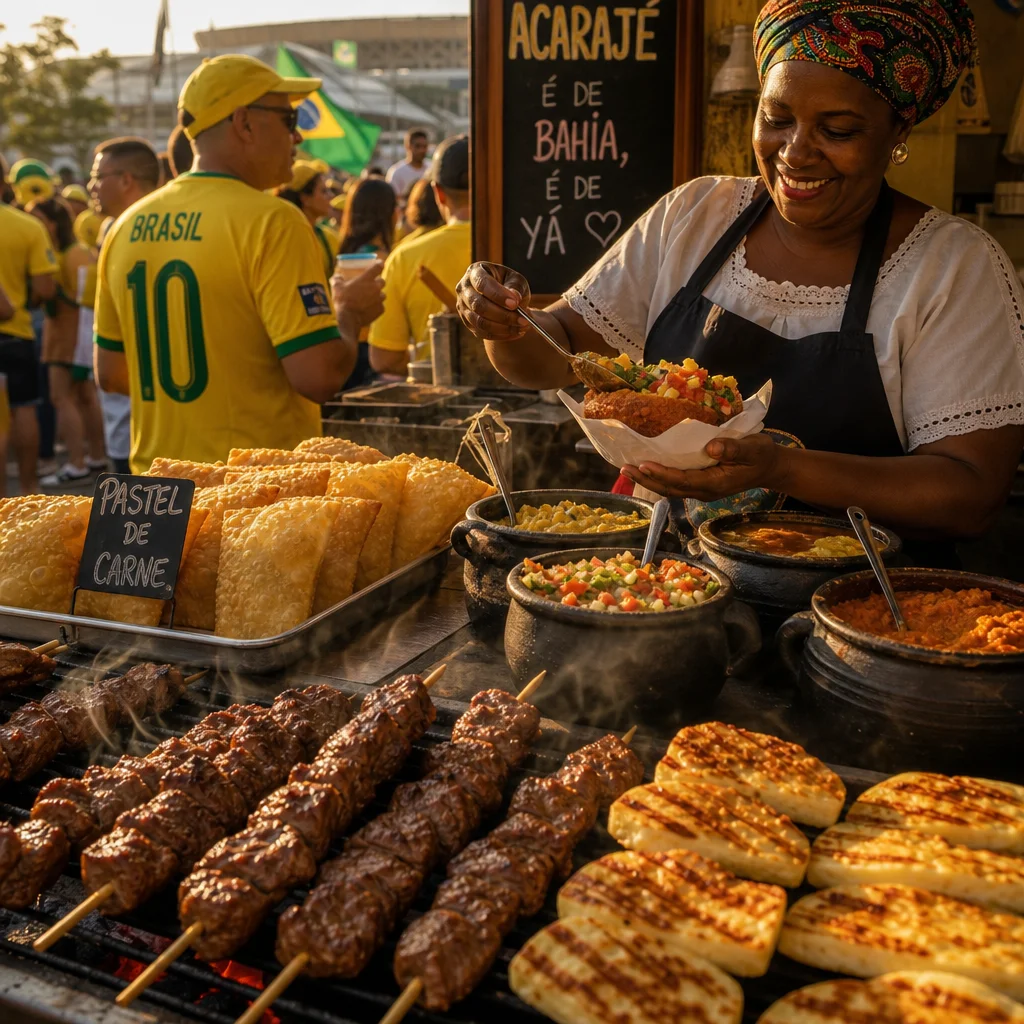
Brazil is a country where eating happens on the pavement as naturally as breathing. From the moment the sun breaks over Copacabana to the final hiss of charcoal embers dying down after a fiercely contested football derby, mobile vendors, tiny corner counters, and improvised drum-can grills keep the nation fueled, energized, and deeply connected. Brazilian street food is not a single, uniform cuisine; rather, it is a living dialogue between Indigenous traditions, West African heritage, Portuguese colonialism, and waves of Japanese, Italian, and Middle Eastern immigration. The result is a loud, generous, and remarkably affordable culinary landscape that rewards anyone willing to follow the scent of boiling dendê oil and woodsmoke.
What elevates this food culture is its precise choreography with the clock. Street eating in Brazil follows the strict rhythm of the day and the pulse of the local calendar. Mornings belong to piping-hot pão de queijo and dark coffee; afternoons shift toward crispy pastel and prato feito lunches, followed by sugarcane juice and heavy-hitting snacks as the sun dips; nights belong to boteco tables, smoking skewers, and sweating bottles of pilsner. When a match day hits, this daily rhythm supercharges, turning ordinary sidewalks into open-air kitchens where the aroma of grilled meat competes with the roar of the crowd. Understanding this timeline is the absolute fastest passport to eating well across the country.
Acarajé: the Afro-Brazilian soul of Bahia in a paper wrap
If your journey through Brazilian street food starts anywhere, let it begin with acarajé. This deep-fried black-eyed pea fritter, plunged into boiling red dendê palm oil, is the undisputed culinary badge of Salvador da Bahia and its surrounding coast. Split open while blistering hot, it is stuffed with vatapá—a velvety, complex paste made from ground bread, coconut milk, roasted peanuts, and dried shrimp—then layered with caruru (okra stew), extra dried shrimp, fresh green salad, and a lethal drizzle of hot pepper oil.
Acarajé is far more than a convenient snack; it is a edible archive of the transatlantic slave trade and a proud pillar of Candomblé religious tradition. The legendary baianas de acarajé, unmistakable in their billowing white lace dresses and turbans, treat their craft as an ancestral inheritance passed down through generations. Buying one is an act of cultural immersion. The rulebook is refreshingly brief: accept the hot pepper if you can handle it, eat it standing directly at the stall, and keep a stack of napkins ready for the inevitable oil drips.
Pastel, coxinha, and the sacred geometry of the deep fryer
Every urban neighborhood in Brazil features at least one open-air market or street corner where oil bubbles away in a wide, shallow metal pan. The *pastel* reigns supreme here: a tissue-thin, bubbly wheat pastry folded over fillings of spiced minced beef, melted mozzarella, shredded chicken, or hearts of palm, then flash-fried until its blistered crust turns golden and shatteringly crisp. It is almost always paired with a cold plastic cup of freshly pressed sugarcane juice (*caldo de cana*), a legendary sweet-and-salty combination.
The *coxinha* is its natural counterpart, a teardrop-shaped croquette featuring shredded chicken and creamy *catupiry* cheese encased in a dense dough, rolled in breadcrumbs, and deep-fried. Food lore attributes its 19th-century invention in São Paulo to a royal chef catering to a young prince who exclusively ate chicken thighs—hence the name, meaning “little thigh.” Alongside *bolinha de queijo* (cheese balls) and *risoles*, these snacks form the backbone of a massive convenience-food economy stretching from interstate bus terminals to birthday parties. The ultimate test of a great pastelaria is simple: a grease-free exterior, a steaming moist interior, and zero heavy aftertaste.
The grill outside the stadium: churrasco and match-day logic
Match-day food culture in Brazil is anchored by a fundamental social truth: nobody celebrates alone, and nobody watches a game on an empty stomach. Two hours before kick-off, the asphalt surrounding iconic stadiums like the Maracanã in Rio or the Mineirão in Belo Horizonte transforms into an ocean of improvised smoke. Vendors wheel out cut-down 55-gallon oil drums converted into charcoal grills, threading thick cubes of beef, chicken hearts, salty pork sausages, and blocks of *queijo coalho* onto long metal skewers.
Stadium food must be functional: fast, portable, and easily managed with one hand while the other grips a plastic cup of beer. Skewers dominate, alongside *torresmo* (deep-fried pork belly crackling that shatters between the teeth) and *pão de alho* (baguette rolls stuffed with heavy garlic butter and toasted directly over the coals). Vendors pitch their goods like theatrical performers, belting out team chants between transactions. For thousands of fans, the ritual outside the turnstiles is just as vital as the ninety minutes on the pitch.
Feijoada and the sacred Saturday ritual
While *feijoada*—the slow-simmered black bean stew loaded with various cuts of pork—is technically a sit-down affair rather than finger food, it dictates the rhythm of the entire weekend. In Rio de Janeiro and Minas Gerais, Saturday is universally reserved for this rich feast, accompanied by white rice, paper-thin shredded collard greens, toasted *farofa* (cassava flour), orange slices, and crunchy pork crackling.
The orange is far from a decorative garnish; its high acidity cuts through the heavy, unctuous fats of the pork and resets the palate after every spoonful. Born out of resourcefulness, the dish reflects the historic no-waste philosophy of Brazilian kitchens. Families cook it in industrial-sized cauldrons designed to feed unexpected visitors. Should you be lucky enough to score an invitation to a Brazilian home on Saturday afternoon, arrive starving, accept a second helping without hesitation, and never refuse the accompanying caipirinha.
Boteco culture: petiscos, ice-cold beer, and hours of debate
The *boteco*—the unpretentious neighborhood tavern—is the beating heart of Brazil’s social fabric. Here, plastic tables spill out onto the pavement, industrial refrigerators keep bottles of beer buried in sub-zero frost, and the menu is engineered for endless sharing. The food is categorized as *petiscos*: small, robust plates designed to anchor a conversation that easily stretches across four hours.
Order *bolinho de bacalhau* (salt cod fritters) alongside *pastel de camarão* or a simple plate of cured olives and cheese. In São Paulo, look for the classic *pão com bife* (steak sandwich). In Belo Horizonte, the bar food culture reaches a gourmet yet accessible peak. The unwritten social laws are uniform: pour beer for your neighbors before filling your own glass, order food progressively rather than all at once, and never rush. At a boteco, the table is a communal arena for debating football tactics, national politics, and the cost of living.
What to drink: from lethal caipirinhas to roadside sugarcane juice
No exploration of Brazilian street consumption is complete without the *caipirinha*, the national cocktail born from a potent mix of cachaça, fresh limes, white sugar, and crushed ice. While polished versions appear in cocktail bars globally, the street-side iteration—generously poured, intensely tart, and served in simple plastic cups—carries a raw, authentic kick. For a non-alcoholic revival, *caldo de cana* is mechanically pressed from raw sugarcane stalks in front of your eyes, offering an intensely sweet, grassy hit that cools down humid tropical afternoons.
Then there is *mate gelado*, the iced herbal tea sold by sprinting vendors along Rio’s beaches, drawn straight from massive stainless steel tanks strapped to their backs. Listen for their melodic, rolling chants across the sand. For a caffeine fix, skip fancy brewing methods: a short, dense espresso at a bakery counter (*padaria*) is a universal ritual, and ordering two back-to-back raises no eyebrows.
Regional stars worth traveling across the country for
Because Brazil is continental in scale, street food shifts dramatically as you cross state lines. In Belém, deep in the Amazon basin, *tacacá* is served in deep gourd bowls—a steaming, sour broth made from fermented *tucupi* juice, tingling *jambu* leaves (which lightly numb the lips), and dried shrimp. In São Paulo, the legendary *bauru* sandwich—stuffed with roast beef, melted cheeses, pickles, and tomatoes—was invented by a hungry student in the 1930s. In Minas Gerais, warm, chewy *pão de queijo* made with local artisanal cheese and tapioca starch is consumed at dawn, noon, and midnight.
Further south, the *churrasco* tradition transitions into a full-scale dining event with continuous *rodízio* service. Along the Santa Catarina coastline, skewered grilled fish dominate the beach strips. Meanwhile, in northern Amazonian towns, *açaí* is traditionally served as a savory, earthy purple pulp alongside fried fish and cassava flour—a far cry from the sweet, granola-topped bowls exported worldwide. The Golden Rule remains constant: eat where the locals are packed deepest, follow the shortest menu, and trust regional traditions.
Sweet endings and morning starts
Street sweets constitute a universe of their own. *Brigadeiro*, the dense chocolate truffle coated in sprinkles, surfaces at every street corner and birthday party. Beside it, you will often find *beijinho* (coconut kisses) and *bolinho de chuva*—small, pillowy fried dough bites dusted generously in cinnamon sugar. Churros stuffed with heavy *doce de leite* are piped fresh from roadside carts.
When morning breaks, the streets reclaim their energy. Vendors fire up *pão na chapa* (butter-slathered bread pressed on a hot griddle) and tapioca crepes filled with white cheese and coconut. Bakery display cases groan under the weight of fresh *pão de queijo*, *sonho* doughnuts, and custard pastries. You stand at the counter, drink your coffee boiling hot, pay your tab with loose change, and step back out into the rhythm of the city—which is precisely how urban life in Brazil was designed to be experienced.
To navigate this culinary landscape like a seasoned local, keep a few practical pointers in mind. Prioritize stalls with high customer turnover; continuous cooking guarantees fresh oil, properly stored ingredients, and honest pricing. Always carry small cash denominations, as neighborhood carts and beach runners rarely process digital payments. Be sensible with street hygiene—opt for peeled fruits and drink bottled water outside major metropolitan areas. Most importantly, learn three essential phrases: *Está quente?* (Is it fresh/hot?), *Quanto é?* (How much is it?), and a sincere *Obrigado* or *Obrigada* to close the transaction. Brazilians eat in the street because that is where communal life truly happens, and sharing a hot, paper-wrapped pastry with strangers after a football match is the closest you will ever get to understanding the soul of the country.