Football as a Second Language and Social Engine
Few nations on earth treat football as merely a sport or a weekend pastime. In Brazil, the game left the professional pitch decades ago to become an underlying rhythm that organizes the working week, colors the architecture of neighborhoods, anchors the family table, and dictates the national calendar. A match is never simply ninety minutes of athletic competition. It is a scheduled appointment with a collective identity, a reason to gather, argue, sing, cook, and embrace strangers. To truly understand Brazilian culture, one must understand how tightly social life and the beautiful game are braided together, forming an unbreakable cultural fabric.
This cultural integration is visible everywhere. From the financial boardrooms of São Paulo to the remote river communities of the Amazon, football serves as a universal social currency. Conversations at bus stops, barber shops, and corner bakeries invariably pivot to the weekend results, managerial decisions, or the latest teenage prodigy signed by a European giant. The game acts as a bridge across vast social divides, uniting people of entirely different economic backgrounds under the common banner of club and country.
From Beach Sand and Asphalt to Concrete Cathedrals
The sport arrived via elite British schools and returning travelers in the late nineteenth century, but it truly took root because it immediately adapted to the existing public spaces of Brazilian cities. Boys and girls played on sweeping beaches, on packed dirt squares, in narrow favela alleys, and on any patch of earth flat enough for two pairs of sandals to serve as goalposts. That improvised grassroots tradition, historically known as futebol de várzea, has never disappeared. It remains alive and well on weekend mornings in every municipality, featuring mismatched kits, hand-drawn chalk lines, and neighbors leaning on chain-link fences to cheer.
Three distinct urban settings shaped the iconic Brazilian style of play. First, the beach, where the ball remains airborne and control must be instant and inventive. Second, the futsal court, where spatial awareness is tight and passing must be razor-sharp. Third, the rough dirt field, where uneven ground rewards improvisation over rigid tactical choreography. Players who grow up mastering these environments develop supreme balance, extraordinary close-quarters control, and a psychological willingness to try the unexpected. The crowd rewards that daring courage with instant applause, even when a flamboyant trick fails.
As formal clubs formed and massive stadiums rose across the country, the sport retained its street-level personality. Concrete cathedrals filled to capacity, yet the very same songs, nicknames, and superstitions traveled seamlessly from the sandlots into the upper tiers. A defender from a rural farming town and a striker from a coastal favela instantly shared a common vocabulary of movement and trickery. This unbroken continuity explains why football feels profoundly accessible rather than elite, and why a working-class supporter can debate tactics with the authority of a professional coach.
The Sacred Rituals of Match Day
Match day in Brazil is an elaborate, multi-sensory ceremony that begins hours before kickoff and extends long after the final whistle. Streets leading to historic venues like the Maracanã in Rio de Janeiro or the Mineirão in Belo Horizonte transform into pedestrian rivers of green, yellow, black, red, and white. Vendors push carts loaded with grilled skewers of meat, cold beers, and traditional snacks, while drum corps beat out polyrhythmic cadences that quicken the pulse of every approaching fan.
Inside the stadiums, organized fan groups known as *torcidas organizadas* orchestrate breathtaking visual displays. Giant banners unfurl across thousands of hands, flares illuminate the smoke-filled air, and deafening chants echo against the concrete bowls. These groups are more than just cheering sections; they function as tight-knit communities, social support networks, and cultural guardians of the clubs they represent. Their members spend weeks hand-painting banners and rehearsing intricate song sheets, treating their role on the terraces as an art form and a sacred duty.
The Backyard Churrasco and Communal Viewing
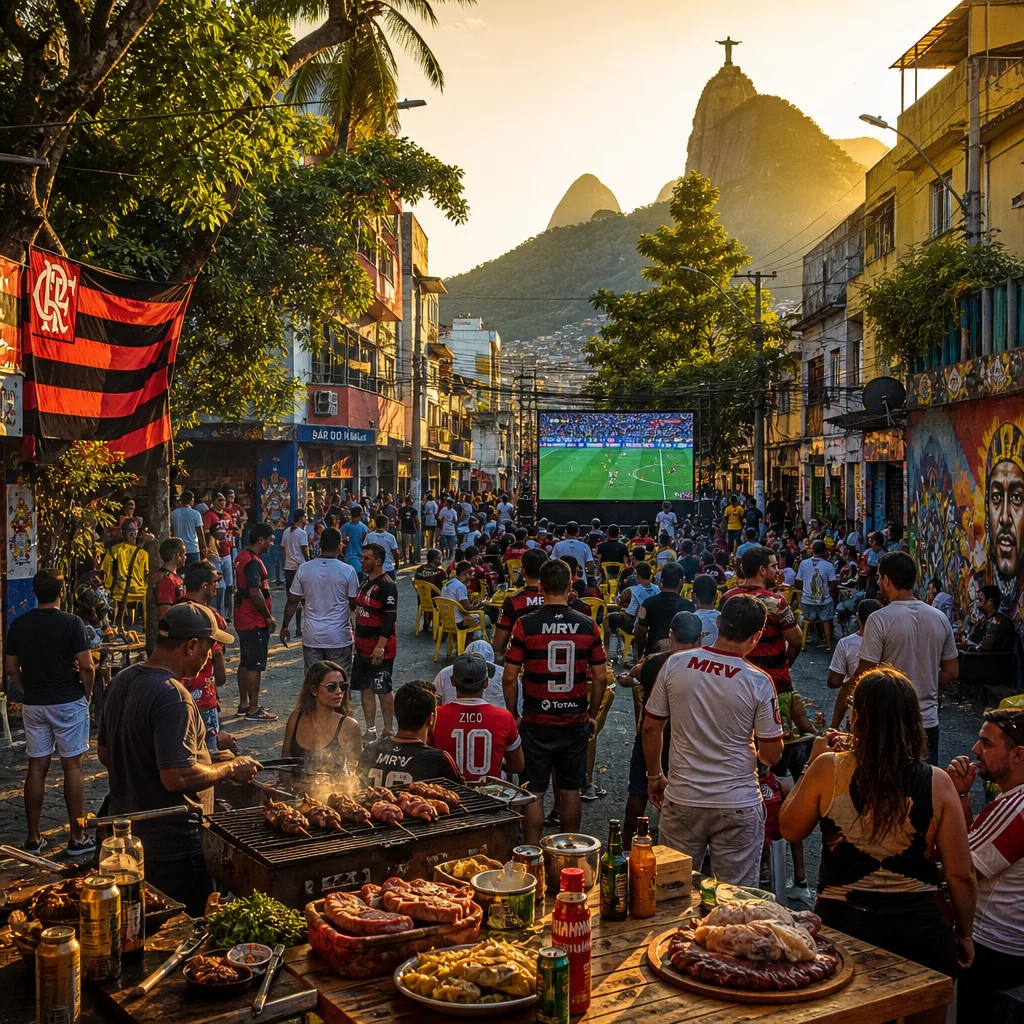
While millions flock to stadiums, an equally vital aspect of Brazilian football culture takes place in private homes, apartment courtyards, and sidewalk bars. The traditional Sunday afternoon *churrasco* (barbecue) is inextricably linked to the match broadcast. Friends and extended family gather around smoking grills piled high with picanha, sausages, and garlic bread, nursing ice-cold pilsners while keeping one eye on the television screen.
During major tournaments like the World Cup or the Copa América, entire neighborhoods undergo a magical transformation. Streets are meticulously painted in national colors, and massive banners depicting legendary players stretch from rooftop to rooftop. On the day of a high-stakes fixture, commercial districts shut down completely. Offices empty out, schools pause classes, and millions converge around television sets. When Brazil scores, the collective roar reverberating from apartment windows across cities sounds like rolling thunder. Strangers hug on sidewalks, car horns blare in unending symphonies, and neighborhood bars overflow with exuberant celebration.
Superstitions, Folklore, and National Mythology
Football in Brazil is deeply intertwined with folklore, superstition, and a sense of national destiny. Fans and players alike cling to elaborate rituals to court good fortune. A lucky jersey worn only during decisive matches, a specific seat on the sofa, or a prayer whispered before a penalty kick are commonplace traditions that reveal the emotional stakes involved.
The nation’s greatest players are elevated to the status of secular saints and cultural icons. Figures like Pelé, Garrincha, Zico, Marta, and Ronaldinho are not merely remembered for their athletic statistics; they are celebrated as artists who gave expression to the soul of the country. Their stories are passed down through generations like folk tales, proving that in Brazil, football culture is the living repository of memory, joy, and collective dreaming.